How much does a click cost with cold email? We sent 120,000 emails to find out
A click costs $4 across the 39 workflows we A/B tested, and $2 on the one we run for clients today. We cut 120,000 cold emails ten ways: a link in the body, the first email, a short message and the right reader move the price 5x.
The question
A cold email is a cheap way to put a link in front of a buyer. Cheap per email. What nobody publishes is what it costs per click: the moment a stranger reads your email and decides to open your website. That number is what a paid channel is judged on, so it should be what cold email is judged on too.
The test
We sent 120,000 cold emails on real campaigns for real clients, across 39 workflows we A/B tested: a workflow is one AI content template and one model. This article prices every one of them, the winners and the ones we retired. Our clients only ever get the winner, so two numbers matter: what a click cost across everything we tested, and what it costs on the workflow we run for you today.
The answer
A click costs $4 across every workflow we tested, with 19 clicks per 1,000 emails. The workflow that won the A/B tests, the one we run for clients today, buys a click for $2.
Below, what moves the price, in order of how much.
The first email does the work
The first email buys a click for $2. The first follow-up buys one for $7. The second follow-up sent 6,381 emails for 19 clicks. Follow-ups earn replies, not clicks: someone who wanted to look at your site did it the first time.
Shorter is cheaper
Under 400 characters, a click costs $1. Over 800, $10. It is not the model: the slope holds inside each tier. It is the reading time. Six paragraphs cost $9 a click against $2 for one, and a subject of 20 characters or fewer beats one over 40.
Flash tier, again
Same finding as our Flash versus Pro study: the cheap tier writes the email that gets clicked. $2 a click with Flash, $6 with Pro. Part of that is the model writing longer. Part of it is the click rate itself: 24 per 1,000 against 14.
Who you write to
A director or a VP clicks for $2 to $1. A C-suite contact, $4. A founder or an owner, $8. Company size runs the same way: a click at a company over 1,000 people costs $1, at a 1 to 10 person company, $12.
Industry moves the price by 10x. Research and hospitals click for $1 to $3, IT for $4. Health and wellness businesses, $10. A practitioner reads email between patients, if at all.
Where they are
A European or Asian recipient clicks for $2, a North American one for $5. France is the cheapest country we can price, $1; the United States the most expensive, $5. Most of our volume is American, so the $4 headline is mostly an American price.
When it lands
Delivered between 9am and 4pm in the recipient's own time zone, a click costs $3 to $2. Between 6am and 8am, $6. The lunch hour is the most interesting bucket and the thinnest: 249 emails, 14 clicks, 56 per 1,000, which would price it under a dollar. We show it and do not price it. Wednesday is the cheapest day, $3; Thursday the dearest, $6.
Best tool for the lowest cost per click
Paid media prices the click openly. We read the pricing page and benchmark report of the eleven tools and agents we compare against: None of them publishes a cost per click. A tool sells sending, an AI SDR sells a seat. Our $2 is the whole bill: the lead, the verified address, the email written for that one person, the mailbox, the follow-ups, the people. No subscription, no retainer.
Best tool for the lowest cost per click: distribute.you, $2 per click, all in. Cheaper than Google Ads ($5.42) and LinkedIn ($5.26 to $8.90). The only cold email provider that publishes a measured cost per click.
Rank
Company
Cost per click
What is in the price
What you pay
Source
1
distribute.you
$2 measured, all in
Lead sourcing, email verification, one email written for each recipient, follow-ups, mailboxes and domains, sending, the team running it, our margin
The budget the campaign spends, from $1 a day. No subscription, no retainer.
This article, 3,861 emails on the workflow we run
2
Google Ads, all industries
$5.42
The click. You write the ads and the landing page.
A click is a small decision made in a few seconds. Everything that shortens those seconds lowers its price: a link to click, a short email, a short subject, a reader who is at their desk in the middle of the day. And everything that makes the reader a decision-maker who does not own the company raises the odds: a director evaluates tools for a living, an owner of a three-person firm does not.
What it means if we run your campaigns
You do not set any of this by hand. Each campaign on distribute.you runs on the workflow with the best measured cost for what it is buying, across every client, and that pick moves as the data above moves. Today that is a click for $2. You pay the budget the campaign spent, nothing else, and the cost of each click lands on your dashboard.
Scope: sales cold email outreach only. Journalist outreach, PR pitches and every other channel we run are excluded.
Window: April 15 to September 9, 2026, every client account. Production data from the distribute.you platform, read on September 9, 2026.
Volume: 120,652 emails to 35,589 people across 33 clients, $7,940 of platform spend. Of those, 28,482 emails to 15,316 people carried a link to the client's site; they cost $2,033 and 530 people clicked. 39 workflows (a workflow is one AI content template and one model); workflows with no tracked spend are excluded.
Click: the sending platform reported that the recipient clicked a link in the email. Counted once per person, on the email they clicked first. The platform does not tell us which link. An email with no link in the body has one anchor, the unsubscribe footer, so its clicks are unsubscribes and those emails are excluded from every price. Emails with a body link carry that footer too; the unsubscribe click rate measured on the others (2.4 per 1,000) bounds how much of their 19 per 1,000 could be the footer, so the true cost of a site click is at most $4.
Pricing: every dollar here is what the client is charged, all in: lead sourcing, email verification, one email written for each recipient, the mailboxes and domains, sending, follow-ups, the team running it and our margin. There is no subscription and no retainer on top. That is what makes it comparable with a paid-media click and not comparable with a sending tool's monthly fee.
Cost per click: spend divided by clicks. Spend is everything the workflow cost before per-account discounts. Each email carries its own workflow's cost per email, so a bucket's spend is the sum over the emails in it.
Buckets: a bucket is priced only with at least 1,000 emails and 20 clicks. Smaller ones are in the tables below without a price, and the lunch-hour bucket is drawn without one.
Tiers: Flash, the cheapest model of a family (Gemini 3 to 3.7 Flash and Gemini 3.5 Flash-Lite ran). Pro, the middle (Gemini 3.1 Pro, DeepSeek V4 Pro and GLM 5.2 to 5.3 ran). The model is read per email from the generation record.
Length, paragraphs, subject, links: measured on the generated text of the email that was sent. A link is a URL or a bare domain in that text; the sending layer turns both into a tracked link.
Recipient: country, seniority, company size and industry from the lead enrichment record. Local time from the recipient's time zone, known for 92% of emails.
Competitor figures: read from each company's own pricing page or benchmark report on the date beside it, quoted as published. We compute nothing from them.
Limits: not a randomised experiment. Our optimiser assigns workflows by measured cost, so the model tier, the length and the audience are correlated with each other. Each cut is reported alone; where a finding holds inside one tier we say so. 530 clicks is a small count. We report counts and no confidence intervals.
 distribute.you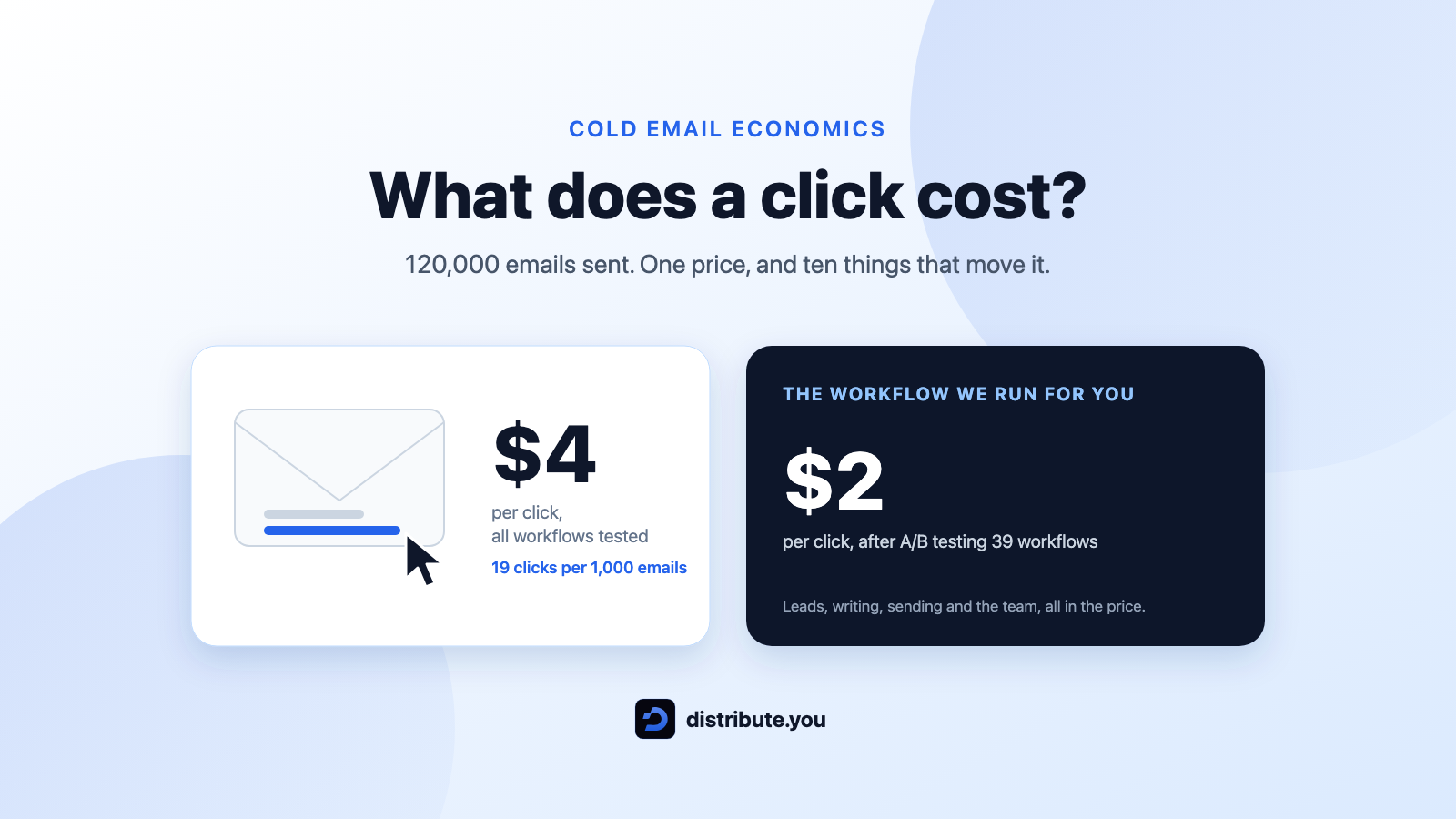
 distribute.you
 Google Ads, all industries
 LinkedIn sponsored content
 Explee AutoGTM
 Instantly
 Smartlead
 Lemlist
 Salesforge
 Apollo.io
 Clay
Clay Gojiberry
 11x
11x Artisan
 AiSDR
AiSDR